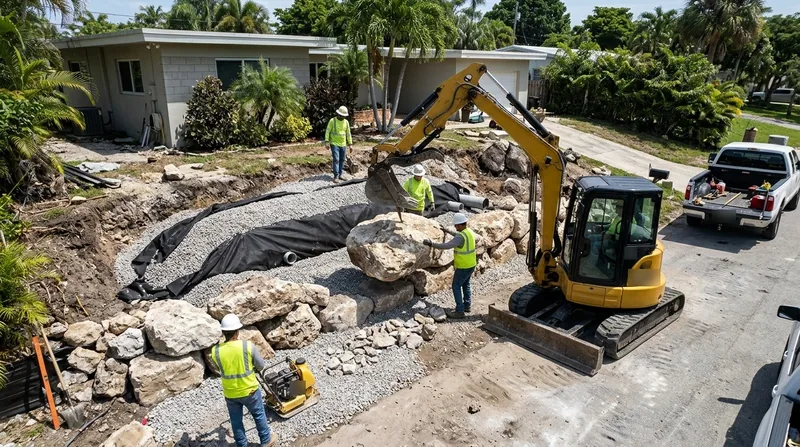




Boulder & Natural Stone Walls in Miami
Miami sits on flat, low ground over porous oolitic limestone, with thin sandy soil and a water table that often shows up just a few feet below grade. The highest natural ground runs along the low limestone ridge through Coconut Grove, Coral Gables, and South Miami, and that is exactly where boulder and natural stone walls make the most sense. Boulder & Natural Stone Walls in Miami give you a wall that looks like it grew out of the tropical landscape instead of being dropped on top of it. We machine-place real rock on a properly prepared base, so the wall holds back soil and drains hurricane rain instead of turning into a soggy, leaning mess. If you are weighing materials, start with our retaining wall installation overview, then come back to this page for the rock-specific details. We work across Miami and the surrounding cities, and we build for the actual soil, water table, and salt air you have here.
Why Boulder & Natural Stone Walls Matter on Miami's Limestone and Fill
Most Miami lots are not natural slopes. They are graded pads cut into oolitic limestone or built up with fill around lakes and canals in Kendall, Doral, and the western subdivisions. When a wall fails here, it usually fails because water piles up behind it during a hurricane rain event or because the water table rises and softens the base. Natural stone walls handle that pressure well when the base and drainage are right. They also suit the 1920s Mediterranean Revival homes in Coral Gables, where coral rock walls are part of the neighborhood character, and the lakefront and pool-deck landscapes from Miami Beach to Palmetto Bay.
- Machine-placed boulders absorb movement from saturated soil better than stacked block, which helps on fill lots near canals.
- Natural stone faces hide the small settlement cracks that show up fast on stuccoed CMU walls after a heavy rain season.
- Open rock joints let water escape instead of trapping it, which lowers pressure behind the wall.
- Coral rock and limestone match the Mediterranean Revival and tropical landscaping look that buyers expect in Coral Gables and Pinecrest.
If your current wall is already leaning or bulging, do not wait for the next storm season. Our leaning and collapsed wall repair team can stabilize it before the damage spreads.
Key info: In Coral Gables, a coral rock wall on a 1920s lot often sits on shallow limestone with almost no soil cover. We pin the base into the rock and run drainage behind the stone, because a wall that just sits on top of the fill will move after the first king tide pushes groundwater up.
Before any wall work starts, check the permit threshold with the local building department. Miami-Dade County publishes its own rules through the Miami-Dade County building department, and the city of Miami has its own review process for walls above roughly 4 feet or walls that carry a surcharge.
How We Build a Natural Stone Wall That Survives Miami Rain and Roots
We do not guess at base depth or drainage. On a typical Miami job, we strip the organics, cut into the limestone or compacted fill, and set a granular base that will not pump when the water table rises. Then we place the rock with a machine, seat each stone, and build the drainage and filter fabric behind the wall as we go up. On lakefront and canal lots in Kendall and Doral, that drainage detail is the difference between a wall that lasts and one that leans within two rainy seasons. Tree roots are the other factor. Ficus and oak roots push walls from behind, so we cut and root-prune where needed and keep the wall line clear of the root plate.
- We walk the site and check the slope, soil, water table, and any tree roots or utilities in the wall line.
- We verify the permit threshold and setback rules with the local building department before we order rock.
- We excavate to the required base depth and compact the subgrade so it will not settle under saturated soil.
- We set the drainage aggregate, filter fabric, and outlet so water has somewhere to go.
- We place the boulders or natural stone with a machine and seat each one for a stable, interlocked face.
- We backfill in lifts, compact, and finish the top so runoff moves away from the wall, not into it.
For a wall that ties into a larger grading and erosion plan, our slope stabilization and erosion control service covers the soil and drainage side of the job.
Key info: On a Homestead lot with sandy fill and a high water table, we set the base deeper and used larger boulders than the plan called for. The homeowner had already lost a timber wall to washout, and the heavier stone with a proper drain outlet has held through two hurricane seasons.
Boulder and Stone Wall Approaches We Use Across Miami
Not every lot calls for the same construction. A pool-deck planter wall in Miami Beach and a 5-foot lakefront wall in Kendall are different jobs, even when both use natural stone. We match the approach to the load, the soil, and the access. Here is how the main options compare.
| Approach | Description | Best for |
|---|---|---|
| Machine-placed boulder wall | Large rock set with an excavator on a compacted base, with drainage stone behind the face. | Lakefront and canal lots in Kendall and Doral with fill soil and high water. |
| Coral rock wall | Oolitic limestone or coral rock laid to match the neighborhood's historic look. | Coral Gables and South Miami homes where character and resale value matter. |
| Stacked natural stone veneer over structural base | A structural wall with natural stone facing for a clean, durable finish. | Pool decks and planter walls in Miami Beach and Pinecrest. |
| Tiered boulder wall | Two or more shorter walls stepped up a slope, each with its own drainage. | Sloped yards in Hialeah and Miami Gardens where a single tall wall would need engineering. |
Every one of these options depends on the same thing: a base that will not move and drainage that actually works. If the drainage is wrong, the rock type will not save the wall.
Boulder & Natural Stone Walls Cost in Miami: What to Expect
Boulder and natural stone walls start at From $25 per square foot for a straightforward wall with good access. That figure covers the base prep, drainage stone, filter fabric, and machine placement. The price moves up when the job gets harder: tight access behind a pool cage, deep excavation into limestone, a wall that needs engineered drawings, or a lot where the rock has to be carried by hand. On a Coral Gables lot with a narrow driveway, we may spend more time moving material than building the wall, and that shows up in the estimate.
- Wall height and length set the rock volume, and taller walls need more base and more drainage.
- Access decides whether we can use a machine or have to move rock by hand.
- Soil and water table can require deeper excavation and heavier drainage on canal lots.
- Permits and engineering add cost on walls above the local threshold or walls that carry a surcharge.
- Rock type and finish changes the material price, with coral rock and select boulders costing more than standard fieldstone.
Get two or three written estimates and compare the base depth and drainage scope, not just the number. A low bid that skips drainage is not a lower price, it is a shorter wall life. Our full pricing overview breaks down the line items so you can compare bids fairly.
Boulder & Natural Stone Walls Near Me: How to Hire a Retaining Wall Contractor Near Miami
Hiring for a natural stone wall is mostly about verifying the basics before anyone touches your yard. Ask for the license and insurance certificate, then confirm the coverage is current for the work being done. Get at least three estimates, and ask each contractor how they handle the base, drainage, and permit threshold. Ask for local references, especially on walls built in the last two rainy seasons, because that is when a bad base shows up. If your property is in a historic district or has protected trees, confirm the permit path before work starts. And if you are in an HOA, get the architectural approval in writing before the rock arrives.
- License and insurance: ask for the certificate and verify it covers retaining wall work.
- Written estimates: compare base depth, drainage, and rock quantity, not just the total.
- Local references: ask for walls built at least two years ago and go look at them.
- Permits: confirm who pulls the permit and whether engineered drawings are required.
- HOA and historic rules: get approvals in writing before the schedule is set.
When you are ready to talk through your wall, contact us for a free estimate and we will walk the site with you.
Boulder & Natural Stone Walls in Miami: Pricing Guide
| Service | Price | Details |
|---|---|---|
| Boulder wall, good access | Starting at $25/sq ft | Includes base prep, drainage stone, filter fabric, and machine placement on an accessible lot. |
| Coral rock or select stone wall | Starting at $32/sq ft | Premium rock and hand finishing for character-driven Coral Gables and South Miami homes. |
| Tight access or hand-carry | Starting at $38/sq ft | Rock moved by hand behind pool cages, narrow drives, or steep rear yards. |
| Tiered or engineered wall | On estimate | Multiple wall lines, surcharge loads, or walls above the permit threshold need an on-site look. |
| Travel | Included | In Miami and surrounding areas, no separate call-out or mileage fee. |
| Estimate | Free | Response within 24h at (786) 741-7917, no obligation to book. |
Indicative pricing, the exact cost depends on square footage, finish, and site access. Free personalized estimate within 24h at (786) 741-7917.


