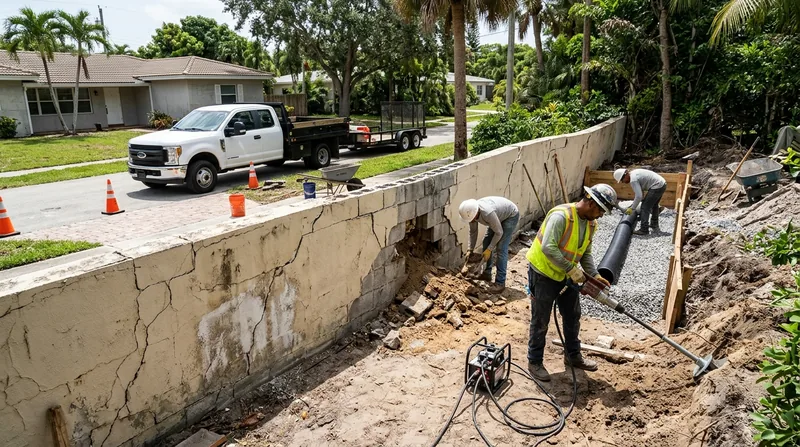




Retaining Wall Repair in Miami
Miami sits on porous oolitic limestone with a thin sandy cap, and the water table can be only a few feet down. That combination means Retaining Wall Repair in Miami is rarely just a cosmetic job. Walls here fail from hurricane rain, king tides pushing groundwater up, salt air eating mortar, and ficus and palm roots prying blocks apart. From the coral rock walls of Coral Gables to the stuccoed CMU planter walls behind Miami Beach seawalls, the failure modes are local and specific. We repair leaning, bowing, cracked, and settling walls before they become collapses. If you are weighing repair against a full rebuild, start with our retaining wall replacement page to see when replacement makes more sense.
Why Retaining Wall Repair Matters More in Miami Than Most Homeowners Expect
Miami's flat, low ground and shallow groundwater put constant hydrostatic pressure behind every wall. When drainage clogs or weep holes seal, water builds up and pushes the wall out. Salt air degrades mortar and stucco, and fast-growing roots in Kendall and Doral subdivisions find every joint. The result is leaning, bowing, and cracking that gets worse every rainy season. Repairing early costs a fraction of rebuilding after a collapse.
- Hydrostatic pressure from king tides and summer downpours pushes walls out of plumb.
- Ficus, palm, and oak roots crack CMU block and lift segmental caps.
- Salt air and poor drainage rot timber and railroad tie walls from the inside.
- Washout under footings causes settlement and sudden lean in sandy soil.
Each of these failure modes has a targeted repair, and catching them early is what keeps a repair from turning into a replacement.
Key info: In Coral Gables, 1920s coral rock walls often lean because original drainage was never installed. We core new weep holes, add gravel and filter fabric, and tie the wall back rather than tear out historic stone.
For official guidance on when a wall needs a permit, check the Miami-Dade County building department before any structural repair begins: Miami-Dade County Building Department.
How We Repair Retaining Walls in Miami, Step by Step
We start by diagnosing why the wall moved, not just where it cracked. In Miami, that usually means checking drainage, groundwater, and root intrusion before we touch the wall face. Then we build a repair plan that matches the wall type, whether it is stuccoed CMU, oolitic limestone, segmental block, or old timber. Every repair is engineered to handle the local soil and water table.
- We inspect the wall, footing, and drainage, and probe the soil behind it.
- We identify the failure cause: water, roots, settlement, or lost tiebacks.
- We correct drainage first with weep holes, gravel, and filter fabric.
- We stabilize the wall with tieback anchors or helical piers where needed.
- We rebuild cracked or displaced sections and match the original finish.
- We test drainage and backfill with compacted, free-draining material.
This sequence stops the movement before we cosmetically patch the wall, which is what keeps the repair from failing again next storm season.
Key info: A Doral pool deck wall was bowing 3 inches after a summer of heavy rain. We installed tieback anchors, rebuilt the drainage behind it, and re-stuccoed the face in four days without touching the pool.
If the wall has already collapsed or is leaning severely, see our leaning and collapsed wall repair service for emergency stabilization.
Repair Methods We Use on Miami Walls
| Approach | Description | Best for |
|---|---|---|
| Drainage correction | Weep holes, gravel, filter fabric, and surface drains to relieve hydrostatic pressure. | Bowing walls with wet soil behind them. |
| Tieback anchors | Galvanized anchors driven into stable soil and tensioned to pull the wall back to plumb. | Leaning CMU and segmental walls. |
| Helical piers | Screw-in piles that underpin the footing and stop settlement in sandy soil. | Settling walls near canals and lakes. |
| Partial rebuild | We remove and rebuild failed sections, matching block, stone, or stucco finish. | Cracked or crushed wall sections. |
| Root barrier and removal | We cut intruding roots and install barriers to protect the wall long term. | Walls cracked by ficus and palm roots. |
Retaining Wall Repair Cost in Miami: What to Expect
Most retaining wall repairs in Miami start around $1,500 for drainage correction and minor section rebuilds. Leaning wall repairs with tieback anchors typically run higher because they require engineering and anchor installation. Full partial rebuilds on long walls can reach several thousand dollars. The biggest cost drivers are wall height, access, the repair method, and whether engineered drawings are required.
We recommend getting 2 to 3 written estimates so you can compare scope, not just price. A low bid that skips drainage will fail again after the next storm. For a detailed breakdown by repair type, see our retaining wall pricing page.
What to Look for When Hiring a Retaining Wall Contractor Near Miami
Hiring the right contractor matters more on retaining walls than on most home projects because a bad repair can fail suddenly. Look for a contractor who is fully insured in Florida, who diagnoses drainage before patching cracks, and who provides written scope and references. Ask whether permits are required for your wall height and whether your HOA has design rules. A good contractor will answer all of this before asking for a deposit.
- Confirm the contractor is fully insured and ask for a certificate.
- Get at least two written estimates with itemized scope and materials.
- Ask for local references on similar wall types and neighborhoods.
- Verify who pulls permits and whether engineered drawings are needed.
- Check HOA rules for wall height, material, and color in your subdivision.
Taking these steps protects your investment and keeps the repair compliant with local rules.
Ready to schedule an inspection? Contact us for a free estimate at (786) 741-7917.
Retaining Wall Repair in Miami: Pricing Guide
| Service | Price | Details |
|---|---|---|
| Drainage correction and weep hole repair | Starting at $1,500 | Includes clearing blocked drainage, adding weep holes, gravel, and filter fabric to relieve pressure on a bowing wall. |
| Tieback anchor installation for leaning walls | Starting at $2,800 | Includes engineering, galvanized anchors, and tensioning to pull a leaning wall back to plumb in stable soil. |
| Partial rebuild of cracked or crushed sections | Starting at $3,500 | Includes demolition of failed sections, new footing where needed, and matching block, stone, or stucco finish. |
| Helical pier underpinning for settling walls | On estimate | Requires an on-site look at soil, water table, and footing depth before a number is given. |
| Emergency stabilization for collapsed walls | On estimate | Urgent shoring and temporary support priced after inspection of the failure and adjacent structures. |
| Estimate | Free | Response within 24h at (786) 741-7917, no obligation to book. |
Indicative pricing, the exact cost depends on square footage, finish, and site access. Free personalized estimate within 24h at (786) 741-7917.


