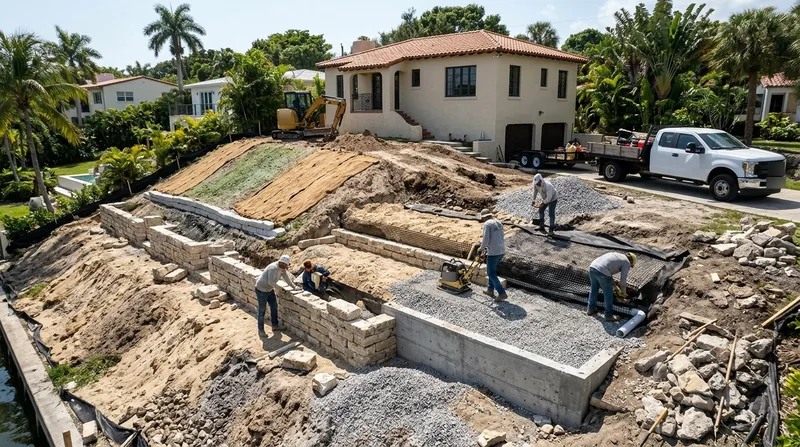




Slope Stabilization & Erosion Control in Miami
Miami sits on flat, low ground over porous oolitic limestone, with thin sandy soil and a water table that often rises to within a few feet of the surface. That geology makes Slope Stabilization & Erosion Control in Miami a different job than it is in hilly states. The highest natural land here is the low limestone ridge running through Coconut Grove, Coral Gables, and South Miami, and even that ridge erodes fast when hurricane rain sheets off a raised pad. We build terraced walls, geogrid reinforcement, and drainage systems that hold lake banks, canal edges, and raised lots in place. If you own a home in Kendall or Doral backfilled around a subdivision lake, or a 1920s Coral Gables property with an old coral rock wall, the soil under your yard is already moving. Call Miami Retaining Wall at (786) 741-7917 for a free estimate before the next storm season opens the ground up.
Why Slope Stabilization Matters on Miami's Flat Limestone Ground
Miami's problem is not steep hillsides. It is sandy fill over porous limestone that loses bearing strength the moment it stays saturated. A raised pad in Miami Gardens or a lake bank in Cutler Bay can look solid for years, then slump after three days of tropical rain. Salt air and tree roots finish the job on older walls.
- Hurricane rain saturates the thin sandy topsoil and pushes it downhill against walls and seawalls.
- King tides and a rising groundwater table soften the limestone base under pool decks and driveways.
- Washout at downspouts and swales undercuts footings on 1950s concrete block homes in Miami Shores and Little River.
- Ficus and palm roots pry apart coral rock walls in Coral Gables and South Miami.
- Lakeside lots in Kendall and Doral lose bank soil every wet season without geogrid and riprap.
Left alone, each of these failure modes turns a small stabilization job into a leaning or collapsed wall repair.
Key info: A Coral Gables homeowner on a ridge lot called us after a downspout washed a 3-foot gully under a 1920s coral rock wall. We stabilized the bank with geogrid and a drainage blanket instead of replacing the historic wall.
For official permit thresholds and setback rules, always confirm with the local building department, since requirements vary by jurisdiction. The Miami-Dade County building department is the authority for unincorporated areas.
How We Stabilize Slopes and Stop Erosion in Miami
We start by reading the water, not the wall. On Miami's flat ground, most erosion begins where runoff concentrates, so we map the high points, the swales, and the water table before we spec a single block. Then we build the fix from the footing up, with drainage behind it so the wall is never asked to hold back water it was not designed for.
- We walk the lot and mark the erosion scarps, sinkholes, and seep lines with the homeowner present.
- We probe the soil depth to limestone and check the water table after rain, not during a dry spell.
- We design the terrace, wall height, and geogrid layout to match the surcharge, whether it is a driveway, pool deck, or empty yard.
- We excavate to stable material and compact the subgrade in lifts before any block goes down.
- We install drainage aggregate, filter fabric, and perforated pipe to daylight so hydrostatic pressure never builds.
- We place geogrid in the reinforced zone and lock each course to the grid as we build.
- We finish the bank with riprap, sod, or native plantings and test the outlet under running water.
Every stabilization job ends with a water test, because a bank that drains is a bank that stays put.
Key info: A Doral subdivision lot behind a community lake was losing about 18 inches of bank a year. We built a two-tier segmental block wall with geogrid and a riprap toe, and the bank has held through two hurricane seasons. See our block and segmental retaining walls page for the materials we used.
Stabilization Approaches We Use Across Miami
No single method fits every bank. A canal edge in Homestead and a pool deck in Miami Beach fail for different reasons, so we match the approach to the water, the soil, and the load above the slope. The table below shows the main options we install.
| Approach | Description | Best for |
|---|---|---|
| Terraced segmental block walls | Two or more short walls with geogrid in each reinforced zone and drainage between tiers. | Lake banks and raised pads in Kendall and Doral. |
| Geogrid reinforcement | Grid layers locked into the wall face and extended into stable soil to resist sliding. | Tall walls and any wall carrying a driveway or structure surcharge. |
| Drainage blanket and toe drain | Aggregate, filter fabric, and perforated pipe that carry groundwater to daylight. | Saturated limestone slopes and yards with downspout washout. |
| Riprap and boulder toe | Graded rock at the water line that absorbs wave and current energy. | Canal edges and seawall backfill in Homestead and Miami Beach. |
| Coral rock and native planting | Local limestone facing with deep-rooted native groundcover to bind the surface. | Historic Coral Gables and South Miami ridge lots. |
We choose the approach that matches your water table and load, not the one that is easiest to sell.
Slope Stabilization & Erosion Control Cost in Miami: What to Expect
Every job starts with a free estimate, and that visit is where the real number comes from. Miami pricing swings widely because the water table, access, and wall height change the scope more than square footage does. A short garden terrace in Pinecrest and a 6-foot reinforced wall on a Doral lake bank are not the same project, even if the footprints match.
Factors that move the price:
- Wall height and the number of terraces, since each tier adds geogrid and drainage.
- Surcharge above the wall, because a driveway or pool deck needs engineered reinforcement.
- Soil depth to limestone and how much excavation the bank requires.
- Water table depth and how much dewatering the site needs during construction.
- Access for equipment, especially narrow lots in Miami Beach and Coral Gables.
- Permit and engineering requirements, which vary by building department.
Getting two or three estimates is smart here, because a low bid that skips drainage or geogrid will cost you a leaning wall repair within a few wet seasons. Our pricing overview breaks down how we scope each line item.
What to Look for in a Retaining Wall Contractor Near Me in Miami
Hiring for slope work is different from hiring for a fence. The contractor needs to understand water, not just block.
Confirm who pulls the permit and whether engineered drawings are required for your wall height or surcharge. In Coral Gables and other historic districts, exterior work can trigger design review, and HOA rules in Doral and Kendall subdivisions may limit wall height and material. A contractor who hesitates on those questions is not the one you want holding your slope.
Reach out through our contact page to schedule your free estimate.
Slope Stabilization & Erosion Control in Miami: Pricing Guide
| Service | Price | Details |
|---|---|---|
| Free on-site estimate | Free estimate | Full slope inspection, water table check, and written scope with no obligation to book. |
| Small bank stabilization | Starting at $2,800 | Short terrace wall with drainage for garden slopes and small washout areas; height and access move the price. |
| Reinforced lake or canal bank | Starting at $9,500 | Geogrid, toe drain, and riprap for lakeside lots; water table depth and bank length drive the total. |
| Tiered or engineered wall system | On estimate | Multiple terraces, surcharge loads, or permit-driven engineering need an on-site look before pricing. |
| Travel | Included | In Miami and surrounding areas, no separate call-out or mileage fee. |
| Estimate | Free | Response within 24h at (786) 741-7917, no obligation to book. |
Indicative pricing, the exact cost depends on square footage, finish, and site access. Free personalized estimate within 24h at (786) 741-7917.


