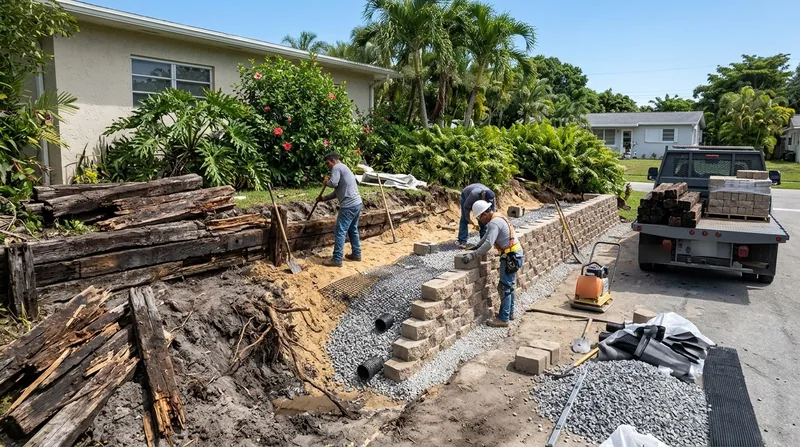




Miami sits on flat, low ground over porous oolitic limestone, with a water table that can rise within a few feet of the surface during king tides and hurricane season. That thin sandy soil and high groundwater punish railroad tie walls from the 1980s and 90s, because the creosote-treated timber rots from the bottom up and the ties bow out under the weight of saturated backfill. Railroad Tie Wall Replacement in Miami means pulling out those failing ties, fixing the drainage that killed them, and rebuilding in segmental block, poured concrete, or natural stone that can handle salt air, hard tropical sun, and roots from ficus and oak. We handle the demolition, haul-away, and rebuild as one job, and we build the wall to drain. If your tie wall is already leaning or bulging, start with leaning and collapsed wall repair before the yard or driveway above it slides.
Why Railroad Tie Walls Fail Faster in Miami Than Anywhere Else
Creosote keeps timber from rotting in dry ground, but it does not stop the cycle of soaking and drying that Miami delivers. Summer downpours push water through sandy fill, the water table rises, and the ties sit wet for weeks. Termites and fungal decay move in, the tie faces spall, and the wall starts to lean toward the street or pool deck.
- Creosote-treated ties from the 1980s and 90s are now 30 to 40 years old and past their service life in this climate.
- Original backfill was often sandy soil with no gravel drain or weep holes, so hydrostatic pressure builds behind the wall.
- Ficus and oak roots in Kendall and Coral Gables heave ties out of line and open gaps that let water in.
- King tides and storm surge in Miami Beach push groundwater up behind seawall lots and saturate the wall base.
- Salt air in Miami Shores and Little River corrodes the galvanized pins and plates that hold timber walls together.
Once the ties are soft and the wall is out of plumb, patching is money down the drain. Replacement is the only fix that lasts.
Key info: A homeowner in Kendall had a 1988 tie wall holding up a raised pool deck. The ties had rotted through at the base and the deck edge had dropped about 2 inches. We removed 60 feet of tie, rebuilt in segmental block with a gravel drain and filter fabric, and tied the new wall into the existing pool deck footing.
Before any work starts, check what your local building department requires. Miami-Dade County publishes permit and inspection guidance through the Miami-Dade County building department, and thresholds vary by jurisdiction and wall height.
How We Replace a Railroad Tie Wall in Miami, Step by Step
Every tie wall replacement starts with a site read: wall height, what the wall is holding up, where the water goes, and how a machine gets to the back yard. In Doral and Homestead subdivisions, access is usually through a side gate and across a lawn. In Coral Gables, we may be working around a 1920s coral rock wall or a protected tree canopy, and the plan changes.
- We mark utilities and confirm the wall height and surcharge with the property owner before demolition.
- We cut and pull the old ties, then haul them off site. Creosote-treated timber does not go in a homeowner's trash cart.
- We excavate to the footing and inspect the soil. If the base is mush, we over-excavate and bring in compacted gravel.
- We install a perforated drain pipe, washed gravel, and filter fabric behind the new wall, and we daylight the outlet.
- We set the new wall in segmental block, poured concrete, or natural stone, compacting lifts as we go.
- We backfill, cap, and clean the site, then walk the wall with you before final payment.
The drainage step is the one that gets skipped on cheap tie wall jobs, and it is the reason the next wall fails. See how we build it on our retaining wall drainage page.
Key info: On a Coral Gables lot near the old coral rock ridge, we replaced 45 feet of tie wall with oolitic limestone caps and a concrete core. The wall held a raised planting bed next to a 1926 Mediterranean Revival house, so the finish had to match the existing coral rock and the footing had to stay clear of the house foundation.
Rebuild Options After the Ties Come Out
Once the old timber is gone, you have real choices, and the right one depends on height, what the wall holds, and how you want it to look. A pool deck wall in Miami Beach and a lake-bank wall in Kendal have different loads and different finishes.
| Approach | Description | Best for |
|---|---|---|
| Segmental block | Interlocking concrete block with gravel core and geogrid on taller walls. | Most residential tie wall replacements up to 4 to 6 feet. |
| Poured concrete | Steel-reinforced concrete wall with formed finish, built on a proper footing. | Walls holding driveways, structures, or heavy surcharge loads. |
| Natural stone or boulder | Oolitic limestone, coral rock, or boulder face with compacted gravel behind. | Coral Gables and Pinecrest lots where the finish has to match the house. |
| Tiered or terraced wall | Two or more shorter walls stepped up a slope with drainage between tiers. | Sloped yards in South Miami and Palmetto Bay where one tall wall is not practical. |
We size the wall to the load and the soil, not to the cheapest block on the pallet.
Railroad Tie Wall Replacement Cost in Miami: What to Expect
Most tie wall replacements in Miami start at $35 per square foot of wall face, and that figure includes demolition, haul-away, new gravel backfill, drainage, and the new wall. A 40-foot wall at 3 feet high runs about 120 square feet, so the starting range is roughly $4,200 and moves up from there.
What pushes the number: wall height and surcharge, access for a machine or a wheelbarrow, whether the old footing has to be over-excavated, the finish you choose, and whether the wall ties into a pool deck, driveway, or structure. Tight lots in Miami Beach and Coral Gables add labor time. A failed wall that has already moved the ground above it costs more than one caught early.
Get two or three written estimates and compare scope, not just the bottom line. Ask whether drainage and haul-away are included. The full breakdown lives on our pricing page.
Railroad Tie Wall Replacement Near Me: What to Check Before You Hire in Miami
Hiring a wall contractor near Miami is mostly about verifying three things: license, insurance, and whether the crew has actually built walls in this ground.
- Confirm the contractor is fully insured for the scope, and ask for a certificate showing general liability and workers' compensation.
- Get two or three written estimates with the same scope so you can compare drainage, haul-away, and finish line by line.
- Ask for local references and go look at a finished wall, especially one in similar soil and height.
- Ask who pulls the permit if your wall is over the local height threshold or holds a driveway or structure.
- Check HOA rules and tree protection rules before demolition, because a protected oak or ficus can change the plan.
If a contractor cannot answer the drainage question, keep calling. Reach us through the contact page for a free estimate.
Ready to get rid of a rotting tie wall? Call (786) 741-7917 and we will look at the wall, the water, and the access before we quote the job.
Railroad Tie Wall Replacement in Miami: Pricing Guide
| Service | Price | Details |
|---|---|---|
| Railroad tie wall replacement, standard access | Starting at $35/sq ft | Includes tie demolition, haul-away, gravel backfill, drainage, and a new segmental block wall; height and finish move the price. |
| Replacement with concrete or natural stone finish | Starting at $48/sq ft | Includes formed concrete or stone facing, footing work, and drainage; wall height and surcharge load are the main cost drivers. |
| Tiered or engineered wall replacement | On estimate | Tiered walls, walls over the local height threshold, or walls holding a structure need an on-site look and possibly engineered drawings. |
| Emergency stabilization before replacement | On estimate | Leaning or collapsed tie walls get shored and made safe first; the stabilization scope depends on how far the ground has moved. |
| Travel | Included | In Miami and surrounding areas, no separate call-out or mileage fee. |
| Estimate | Free | Response within 24h at (786) 741-7917, no obligation to book. |
Indicative pricing, the exact cost depends on square footage, finish, and site access. Free personalized estimate within 24h at (786) 741-7917.


