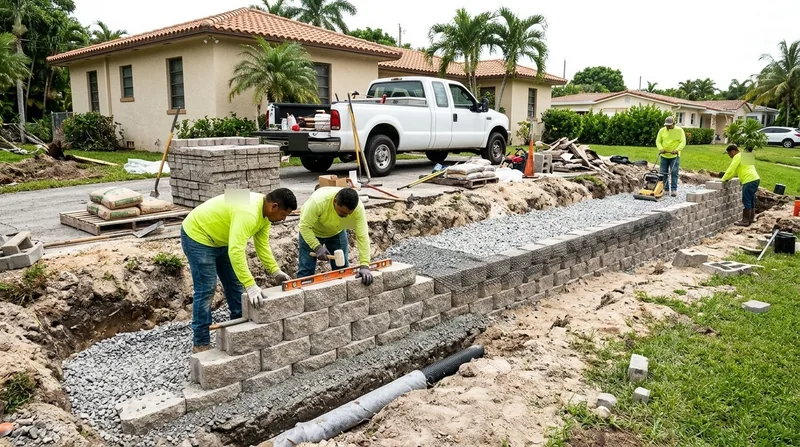




Retaining Wall Installation in Miami
Miami sits on porous oolitic limestone under a thin layer of sandy soil, and the water table often rises to within a few feet of the surface. The highest natural ground is the low limestone ridge that runs through Coconut Grove, Coral Gables, and South Miami. On that ground, Retaining Wall Installation in Miami has to handle hurricane rain, king tides, and salt air, not just hold back dirt. We design and build walls that keep raised lots, pool decks, driveways, and canal-side yards stable for the long run. Whether you need a new wall or want to fix a failing one, we start with the soil and drainage, not the finish. For existing wall problems, see our retaining wall repair service.
Why Retaining Wall Installation Matters on Miami's Limestone and Sand
Miami's thin sandy soil sits on top of porous limestone, and the water table is only a few feet down. When heavy summer rain or a king tide pushes groundwater up, poorly drained walls fail fast. The housing stock adds its own pressure: 1920s Mediterranean Revival homes in Coral Gables with coral rock walls, 1930s to 1950s concrete block houses in Miami Shores and Little River, and 1970s to 2000s subdivisions around lakes and canals in Kendall and Doral. Walls here fail from washout, salt air, and tree roots, not from frost.
- We build proper footings that bear on stable limestone or engineered fill, not loose sand.
- We install gravel backfill and drainage to relieve hydrostatic pressure from rising groundwater.
- We use materials that resist salt air and hard tropical sunlight, from concrete to natural stone.
- We account for tree roots and surcharge loads from driveways and pool decks.
Each of these steps protects the wall from the specific forces that tear walls down in Miami-Dade.
Key info: In Coral Gables, many 1920s coral rock walls look solid but have lost their footing to root growth and washout. We inspect the base before recommending a new wall. For permit thresholds and setback rules, check with the local building department, since requirements vary by jurisdiction. You can also review the Miami-Dade County building department for general guidance.
How We Build a Retaining Wall That Lasts in Miami
We start every job by reading the site: soil depth, water table, slope, and how the wall will be used (planter, pool deck, driveway, or canal edge). Then we match the wall type to the load and the drainage. We do not guess at footing depth on limestone. We verify it.
- We walk the property with you and mark the wall line, checking setbacks and utility locations.
- We excavate to the footing depth and confirm we are bearing on stable material, not loose fill.
- We pour or compact the footing and set the first course level and true.
- We build the wall with the specified material, installing drainage gravel and outlet pipes as we go.
- We backfill in compacted lifts and finish the wall with the cap or stucco you chose.
That sequence keeps the wall stable against Miami's groundwater and rain, not just against the soil it holds.
Key info: In Kendall and Doral, many lots back up to canals and lakes. We often find the original builder placed a wall without drainage, and the water table pushes it out within a few seasons. On a recent job near a Doral canal, we replaced a bulging block wall with a segmental wall on a deeper footing and a gravel drain, and it has held through two hurricane seasons.
For neighborhood-specific details, see our Coral Gables retaining wall installation page.
Retaining Wall Methods We Use in Miami
We choose the wall type based on load, height, finish, and how the wall will be used. Each method has a place in Miami's mix of limestone, sand, and canal-side lots.
| Approach | Description | Best for |
|---|---|---|
| Segmental block (SRW) | Interlocking concrete blocks with gravel backfill and geogrid where needed. | Raised pads, planters, and canal-side yards in Kendall and Doral. |
| Poured concrete | Reinforced concrete wall with formed finish, often stuccoed. | Structural walls supporting driveways or structures. |
| Boulder and natural stone | Oolitic limestone or coral rock set on a compacted base. | Coral Gables and Coconut Grove landscapes with a natural look. |
| Timber | Pressure-treated timber walls for low heights and tight budgets. | Low garden walls and temporary holds before a permanent wall. |
We match the method to the site, not the other way around.
Retaining Wall Installation Cost in Miami: What to Expect
Most retaining wall installation in Miami starts around $30 per square foot, but the final number depends on height, material, access, and what the wall has to hold. A low planter wall on a Coral Gables lot is a different job from a tall wall supporting a driveway in Kendall. We give you a written scope with the footing, drainage, and finish spelled out, so you can compare bids fairly. Get two or three estimates, and make sure each one includes drainage and footing depth. For a fuller breakdown, see our pricing page.
What to Look for When Hiring a Retaining Wall Contractor Near Miami
Hiring the right contractor matters more than the material you pick. Ask for proof of license and insurance, and confirm the policy covers retaining wall work. Get at least three written estimates that specify footing depth, drainage, and material. Ask for references from jobs similar to yours, and check them. If your property is in a historic district or has protected trees, confirm the contractor knows the permit process. In HOA communities, get the architectural review approval before work starts.
To schedule a free estimate, reach out through our contact page.
Retaining Wall Installation in Miami: Pricing Guide
| Service | Price | Details |
|---|---|---|
| Segmental block wall | Starting at $30/sq ft | Includes footing, gravel backfill, and drainage; height and access move the price. |
| Poured concrete wall | Starting at $45/sq ft | Includes reinforcement and formwork; surcharge loads and finish raise the cost. |
| Boulder and natural stone wall | Starting at $40/sq ft | Includes stone selection and setting; tight access and custom shapes increase labor. |
| Timber wall | Starting at $25/sq ft | Includes pressure-treated timber and gravel backfill; low height keeps it economical. |
| Complex or large-scale job | On estimate | Tiered walls, engineered designs, and tight sites need an on-site look before pricing. |
| Travel | Included | in Miami and surrounding areas, no separate call-out or mileage fee |
| Estimate | Free | Response within 24h at (786) 741-7917, no obligation to book |
Indicative pricing, the exact cost depends on square footage, finish, and site access. Free personalized estimate within 24h at (786) 741-7917.


