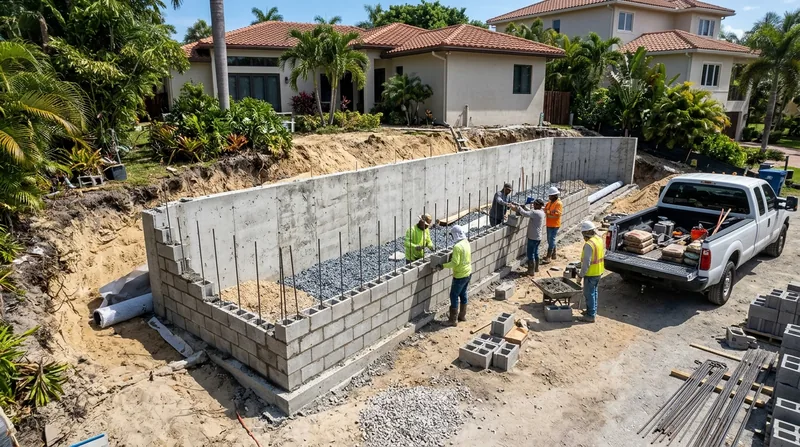




Miami sits on porous oolitic limestone with a water table only a few feet below grade, so a retaining wall here is holding back more than soil. It is holding back water pressure, hurricane rain, and the slow creep of a low, flat lot that wants to drain somewhere. Concrete Retaining Walls in Miami solve the problem that timber and unreinforced block cannot: they carry a surcharge, they resist king tide groundwater, and they keep their line when the ground around them is saturated. We pour and build reinforced CMU walls with engineered footings, rebar, and weep holes for pool decks, driveways, raised pads, and tight city lots from Kendall to Miami Beach. If your wall is already leaning, start with leaning and collapsed wall repair before you plan anything new.
Why Concrete Retaining Walls Matter on Miami's Limestone and High Water Table
The ground in Miami is thin sandy soil over oolitic limestone, and the water table sits close enough that a deep excavation can turn into a swimming hole by afternoon. Old stuccoed CMU planter walls in Miami Shores and Little River, coral rock walls in Coral Gables, and timber walls in 1970s Kendall subdivisions all fail the same way: water gets behind them, the soil washes out, and the wall tips toward the street. Poured concrete and reinforced block handle that pressure far better than stacked material.
- We design footings below the active root and frost zone, which in Miami means getting under the porous limestone cap and onto stable bearing.
- We set vertical and horizontal rebar on a grid so the wall resists overturning from saturated soil after a tropical downpour.
- We install weep holes and gravel drainage behind every wall so groundwater from king tides has a path out instead of pushing the wall over.
- We pour walls that support a surcharge, which is what you need for a driveway, pool deck, or raised pad in Doral or Miami Gardens.
That combination is why concrete is the default choice when the wall has to do real structural work, not just hold a planting bed.
Key info: A pool deck wall in Coral Gables that sits on saturated limestone after a summer storm is carrying water weight the original builder never accounted for. We have re-poured several of these where the old CMU block had cracked along the mortar joints and the deck had begun to settle.
Before any wall goes in, check the permit threshold with the local building department. Miami-Dade County and the City of Miami generally require a permit for walls above roughly 4 feet measured from the footing, or any wall that supports a surcharge, and tall or tiered walls may need engineered drawings. You can verify current rules through the Miami-Dade County permitting portal.
How We Build a Concrete Retaining Wall in Miami, Step by Step
Every wall starts with a site read, not a form. We look at the slope, the water table, the tree roots, and how a truck can reach the back of the lot. In Miami Beach and South Miami, that last part often decides the whole method, because a tight side yard behind a seawall lot will not take a full-size mixer.
- We mark the wall line and call for underground utility locates before anything gets cut.
- We excavate to the footing depth and confirm we are bearing on stable limestone or compacted fill, not loose sand.
- We set rebar cages and form the footing, then pour and cure it before the wall stem goes up.
- We build the wall in reinforced CMU or poured concrete, tying vertical rebar into the footing.
- We install drainage gravel, filter fabric, and weep holes at the base of the wall.
- We backfill in lifts and compact, then finish the face with stucco or a cap to match the house.
Each step is inspected before we move to the next, because a footing poured on the wrong bearing is a wall that leans within five years.
Key info: On a Hialeah lot off 33012, the rear wall sat two feet from a canal bank and the water table was hit at 30 inches. We switched from a deep poured footing to a reinforced CMU stem on a widened shallow footing with a French drain behind it, and the wall has held through two hurricane seasons.
If your project includes regrading the lot, pair the wall with slope stabilization and erosion control so water is directed away from the wall instead of into it.
Concrete Retaining Wall Methods We Use Across Miami
Not every wall needs the same build. A planter wall in Pinecrest and a driveway wall in Miramar carry different loads, and the method should follow the job. Here is how we match the approach to the site.
| Approach | Description | Best for |
|---|---|---|
| Poured concrete wall | Cast-in-place reinforced wall with an engineered footing and rebar grid. | Tall walls, driveways, and structural surcharge loads. |
| Reinforced CMU block | Concrete block stem with grouted cells and vertical rebar, stucco finish. | Pool deck walls, planter walls, and tight city lots. |
| Cantilever wall | L-shaped footing that uses the soil weight on the heel to resist overturning. | Retaining walls over 4 feet with limited right-of-way. |
| Tiered concrete wall | Two or more stepped walls with drainage between each tier. | Sloped lots in Kendall and Palmetto Bay. |
| Concrete wall with drainage system | Weep holes, gravel, filter fabric, and a toe drain tied to the yard. | High water table lots near canals and seawalls. |
The right method depends on wall height, soil, and what sits above it, and we tell you which one fits before you commit.
Concrete Retaining Walls Cost in Miami: What to Expect
Most concrete retaining walls in Miami start around $35 per square foot of wall face, and that figure moves with height, access, and what the wall has to hold. A low planter wall on an open lot in Homestead sits near the bottom of that range. A tall cantilever wall behind a pool deck in Miami Beach, where a mixer cannot reach the back yard and the water table is high, lands well above it.
The biggest cost drivers we see are wall height and footing depth, access for equipment and concrete trucks, the amount of excavation and haul-off, engineering and permit requirements, and whether the wall carries a driveway or structure. A wall that replaces a failed timber wall often costs more than a new build because the old material and rotted soil have to come out first.
Get two or three written estimates on the same scope so you can compare what is actually included: footing, rebar, drainage, finish, and permit. A low bid that skips drainage or engineering is not a lower price, it is a shorter wall life. Our full pricing overview breaks down the line items in more detail.
What to Look For in a Retaining Wall Contractor Near Miami
Hiring for a concrete wall is different from hiring for landscaping, because the work is structural and the permit trail matters. A contractor who cannot show you a completed wall in Miami-Dade is a risk you do not need to take.
- Confirm the company is fully insured, and ask for the certificate to be sent to you directly.
- Get multiple estimates written on the same scope so the comparison is real.
- Ask who pulls the permit and who handles the inspection, because a wall above the local threshold needs both.
- Check references for walls built at least two hurricane seasons ago, not just last month.
- Ask how they handle tree roots and protected trees before excavation begins.
- If you live under an HOA, confirm the wall finish and height are approved before the first shovel hits the ground.
None of this is unreasonable to ask, and a good contractor will hand it over without being pushed.
When you are ready to talk through your wall, contact us for a free estimate and we will walk the site with you.
Concrete Retaining Walls in Miami: Pricing Guide
| Service | Price | Details |
|---|---|---|
| Poured concrete wall | Starting at $35/sq ft | Includes engineered footing, rebar grid, forms, and pour; height and surcharge load move the price. |
| Reinforced CMU block wall | Starting at $32/sq ft | Includes grouted cells, vertical rebar, and stucco finish; access and wall height affect cost. |
| Tiered or tall wall | On estimate | Tiered and tall walls need engineered drawings and site review before a number is realistic. |
| Drainage and weep hole package | Starting at $8/sq ft | Includes gravel, filter fabric, weep holes, and toe drain; high water table lots need this. |
| Travel | Included | in Miami and surrounding areas, no separate call-out or mileage fee |
| Estimate | Free | Response within 24h at (786) 741-7917, no obligation to book |
Indicative pricing, the exact cost depends on square footage, finish, and site access. Free personalized estimate within 24h at (786) 741-7917.


